Photography Books for Beginners vs Pocket Field Cards

A book teaches you why photography works, and a card tells you what to set in the next ten seconds. Neither replaces the other. If you are choosing where to start, this comparison shows what each does well and where each falls short, so you can decide without wasting a month on the wrong one.
Side by side
| Photography book | Pocket field cards | |
|---|---|---|
| Best at | Explaining concepts in depth, showing examples | Giving settings and steps in the field |
| When you use it | At home, on the couch, planning | On location, mid-shoot |
| Speed of lookup | Slow: find the chapter, read the page | Fast: pull one card, glance, shoot |
| Practice built in | Sometimes, in exercises at the end | A drill on every card |
| Images | Rich photo galleries | Simple diagrams |
| Weight in the bag | Heavy | A few printed sheets |
| Staying current | A fixed edition | Easy to reprint and annotate |
| Cost | One purchase, price varies by title | One download, print at home |
What a book does that cards do not
- Builds the big picture. A good book connects exposure, light and composition into one way of seeing.
- Teaches by example. Long image captions and photographer commentary show choices in context.
- Inspires. Browsing great work can lift your ambition.
- Goes deep on history, genres and style, which a card cannot.
If you are curious about why the great photographers composed as they did, a book is the right tool.
What a book does not do
The usual problems for beginners are practical:
- The numbers you need are buried. After you finish a chapter, you still have to remember f/8, 1/125s and ISO 100 at the moment of the shot.
- Weak on specific situations. What are the settings for the full moon, for snow, for a dim birthday party? A general book may cover them in a paragraph, or not at all.
- No prompt to go outside. Reading is easy to confuse with learning.
- Hard to carry. Few people take a book on a walk.
What pocket cards do well
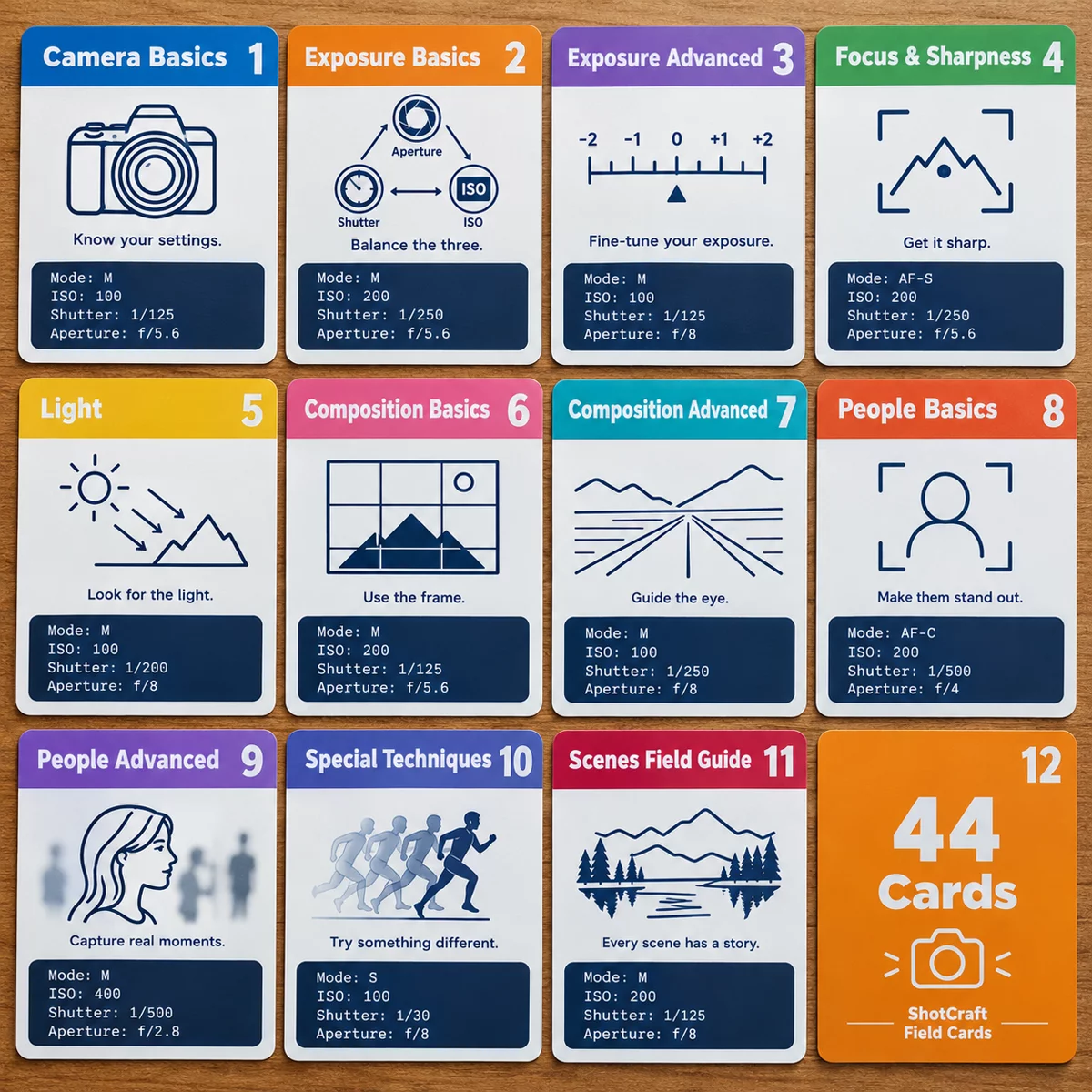
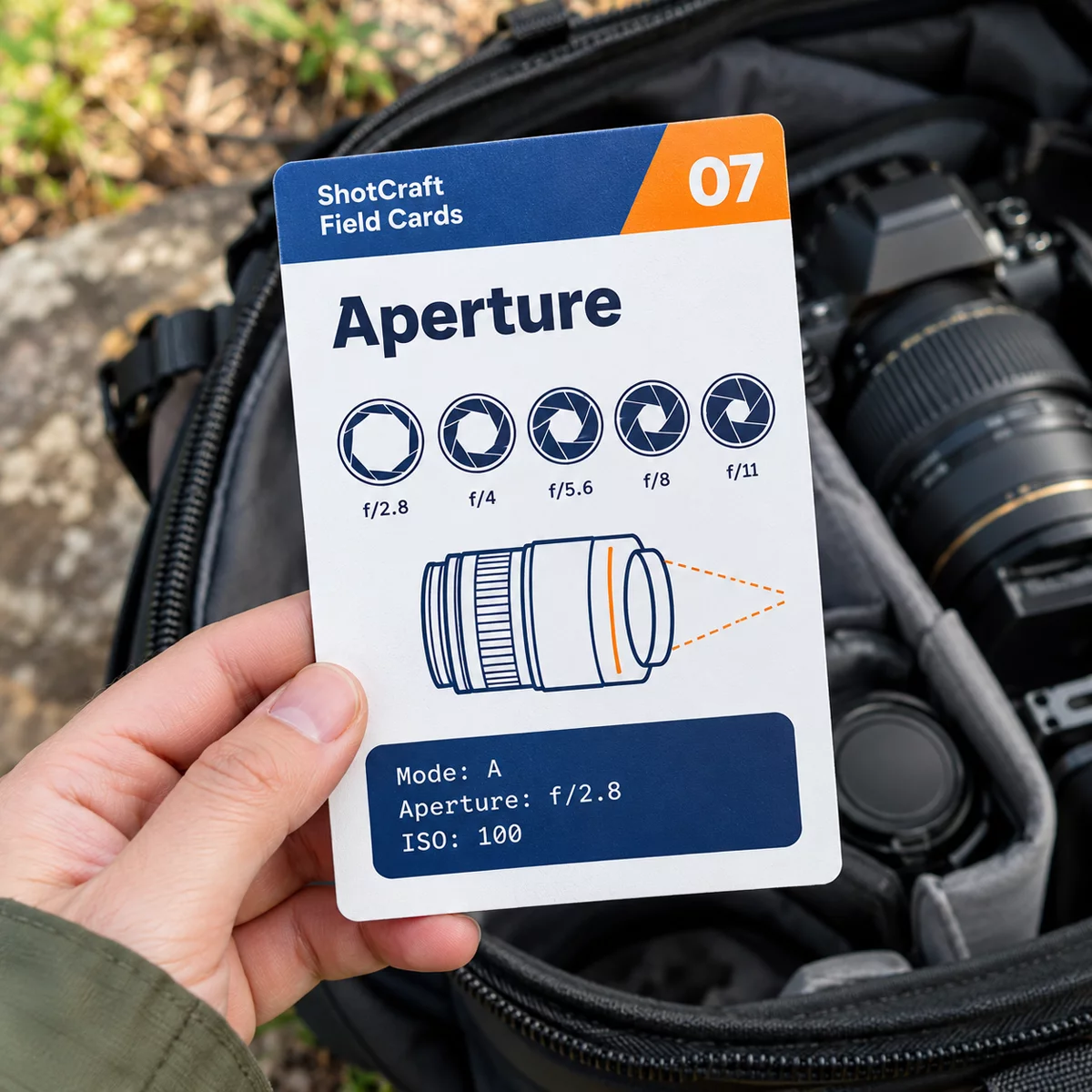
Cards are built for the gap between knowing and doing. The ShotCraft Field Cards are 44 printable cards, one skill each, and every card follows the same pattern: a hook describing the problem, the key idea, numbered steps, starting settings, a try-it drill, common mistakes and a pro tip. That makes them useful for things a book glosses over:
- Ready-to-shoot settings by scene. The bonus Scene Recipe Cards cover 16 situations, including the moon, fireworks, snow, rainy-day reflections, an indoor birthday without flash, a concert or stage, pets and food at a restaurant.
- A Start Here card with the 3 settings behind most photos, and a one-page Quick Settings Sheet.
- Drills, like shooting one subject at four apertures, so you see the effect.
- Checklists, a Shot Log & Settings Tracker and a Lens & Focal Length Guide, printable at A5 or US Letter.
What cards do not do
Honest limits matter. Cards do not replace a long, reasoned explanation, they do not carry the depth of a book on one genre, and they are generic rather than tied to one camera's menus. They also need printing, which is a small cost in time. If you want to understand the history of photography or study a master's portfolio, buy a book.
Which should you start with?
| If you... | Start with |
|---|---|
| Keep forgetting the settings in the field | Cards |
| Want to understand the theory first | A book |
| Learn by practicing | Cards, with a drill on each |
| Want inspiration and ideas | A book |
| Have limited time and want quick wins | Cards |
| Have a long commute or enjoy reading | A book, plus a few cards for weekends |
The best combination
The pattern many beginners settle on is simple: read at home, shoot with cards. Use a book for the explanations, and carry a card for the setting. After each outing, compare what you did with what you read, and adjust. To go deeper on the shortest version, see the camera settings cheat sheet and the exposure triangle guide. For a wider comparison with other formats, read photography cheat sheets compared, and add a 30-day challenge so your reading turns into practice.
About ShotCraft Field Cards
ShotCraft Field Cards is a download of printable cards, not a book. The main set contains the 44 cards, the Start Here card, the Quick Settings Sheet, 16 Scene Recipe Cards, 7 field checklists, the Shot Log & Settings Tracker, a Lens & Focal Length Guide and a Toolkit web app. Portrait, travel and storytelling packs are separate paid add-ons and are not in the main set.