Photography Cheat Sheets Compared: Which Format Is Right for You?
The best photography cheat sheet is the one you will actually pull out while shooting, and that depends on whether you need a reminder, a lesson or a tool. There are five common formats: one-page sheets, printable card sets, apps and calculators, books and videos or courses. This comparison looks at each honestly, including what ShotCraft's own card set is good at and where it falls short.
The formats at a glance
| Format | Best for | Strengths | Weaknesses |
|---|---|---|---|
| One-page sheet | Quick reminders of settings | Fast, compact, easy to print | Little explanation; hard to learn from |
| Printable card set | Learning one skill at a time in the field | Pocket-sized, one idea per card, practice built in | Need to print; more pieces to carry |
| App or calculator | Math and planning, such as sun times or depth of field | Instant, always updated | Screen glare, battery, notifications |
| Book | Deep understanding and inspiration | Rich explanations and images | Not field-friendly; no quick lookup |
| Video or course | Seeing technique demonstrated | Visual, step by step | Hard to use mid-shoot; time heavy |
What a good cheat sheet needs
Whatever you choose, look for five things:
- Concrete starting values, such as "f/8, 1/125s, ISO 100", not only definitions.
- A reason behind each value, so you can adjust it.
- Common mistakes, which shortcut learning.
- A short drill, because skills come from doing.
- Readable at a glance, in poor light and with one hand.
A sheet that lists settings but not why leaves you stuck as soon as the light changes. A tutorial that explains everything but cannot be scanned in ten seconds will stay at home.
The 7 basics a cheat sheet should cover
If you wonder what to look for, the usual list is: exposure, aperture, shutter speed, ISO, focus, composition and light. A solid cheat sheet touches all seven. Start with the camera settings cheat sheet for the settings and the exposure triangle for how they interact.
Which format for which person
| You are... | Try |
|---|---|
| A beginner who wants to stop guessing | A one-page sheet plus a few cards on exposure |
| Someone who learns by doing | A card set with a drill on each card |
| A traveler with limited bag space | A sheet or a few cards, plus a phone app for calculations |
| Someone who wants the theory | A book, read at home |
| A visual learner | Videos for the idea, cards for the field |
| A gift-giver | A printable set that can be delivered instantly |
Most photographers end up combining formats: a book or video to understand, a card in the bag to apply.
Where ShotCraft Field Cards fit
ShotCraft Field Cards are a printable card set. Here is exactly what the ShotCraft Field Cards download contains:
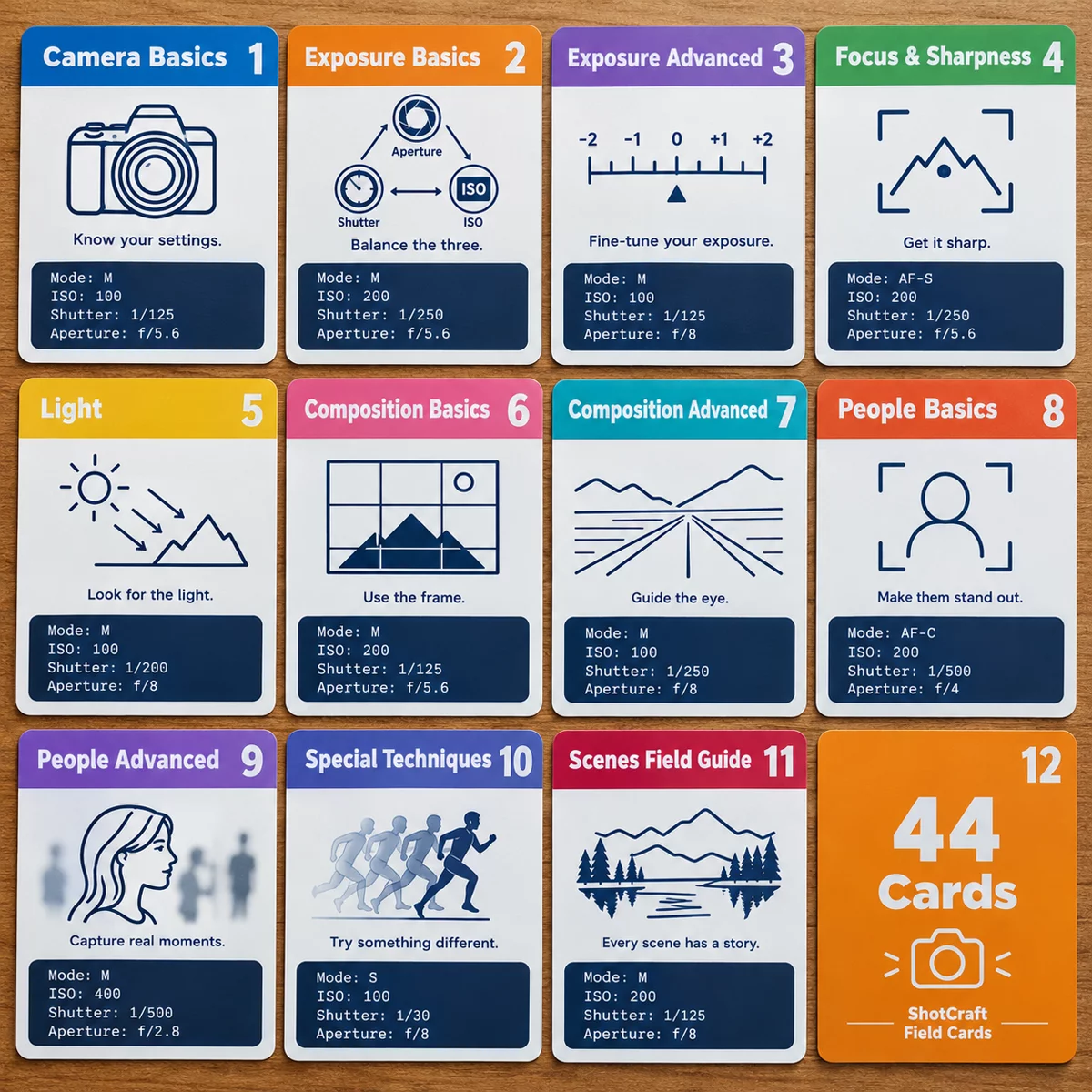
- 44 cards in 11 areas: camera basics, exposure basics, exposure advanced, focus and sharpness, light, composition basics, composition advanced, people basics, people advanced, special techniques and scenes. Each card has a hook, key idea, steps, settings, a try-it drill, common mistakes, a pro tip and a diagram.
- A Start Here card with 3 settings for 80% of your photos.
- A one-page Quick Settings Sheet.
- 16 Scene Recipe Cards: ready-to-shoot settings for scenes such as the moon, fireworks, snow, concerts and food at a restaurant.
- 7 field checklists, a Shot Log & Settings Tracker and a Lens & Focal Length Guide.
- A Toolkit web app with exposure, depth of field, 500 rule and golden hour tools.
- Print files in A5 and US Letter.
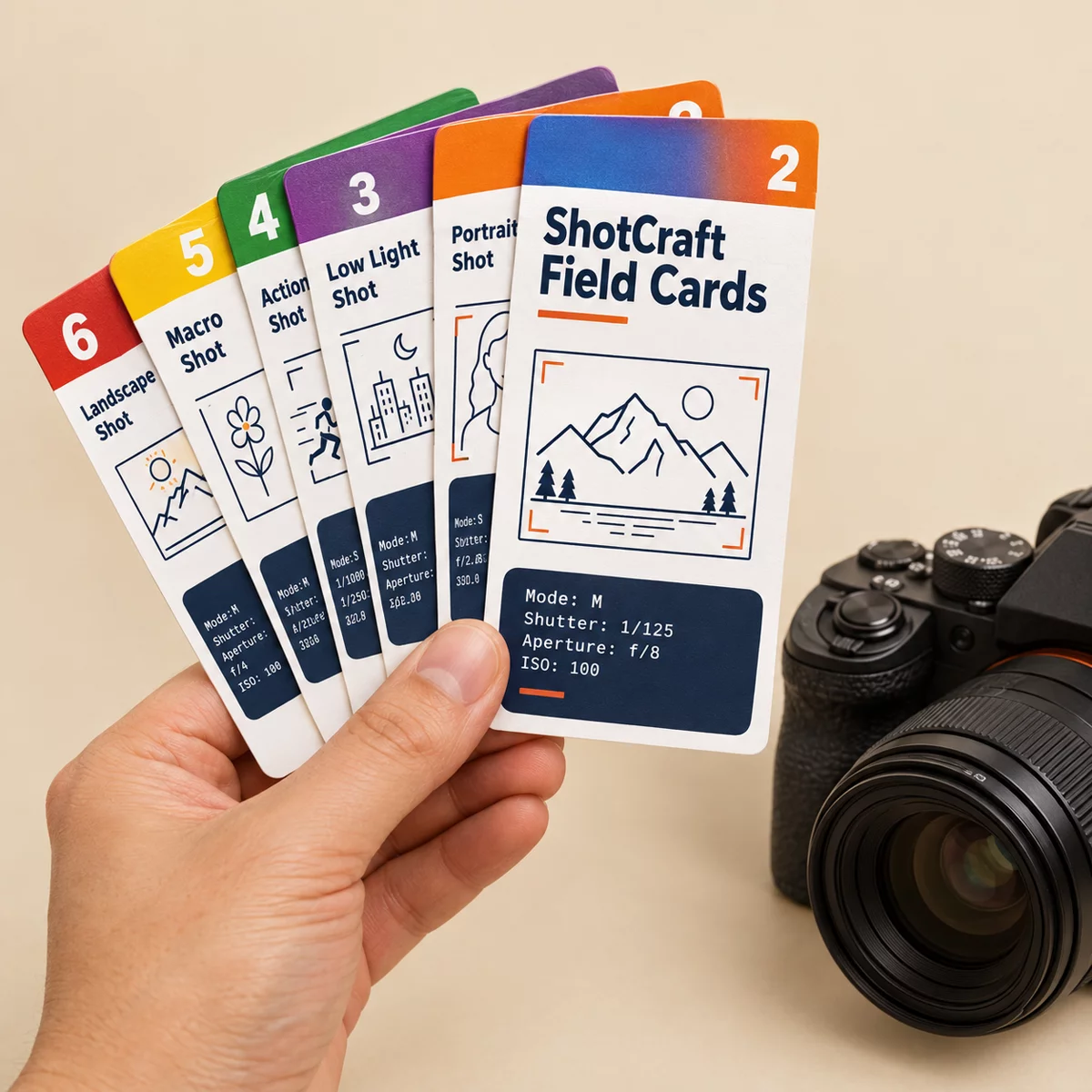
Where it is strong: the field use. Each card is one skill, the settings are on the card, and the drill makes you practice. Where it is not the right choice: if you want long-form theory, a book will go deeper; if you want to watch technique, videos show motion better; and the cards are generic rather than a menu map for one specific camera model. Portrait, travel and storytelling packs are separate paid add-ons and are not in the main set.
How to choose in five minutes
- Write down the last three times a photo went wrong.
- Ask: was it a missing fact, a missing habit, or a missing tool?
- Fact: read a long article or book chapter. Habit: use cards with drills. Tool: use an app.
- Print one page, put it in your bag and use it for a week.
If one format does not work, switch. The goal is more good frames, not more material. If you are comparing books and cards specifically, read photography books vs field cards, and once you have a system, a shot log shows you which settings you reach for most.